
Microsoft AZure
Overview
The Microsoft Azure program introduces learners to core cloud concepts, resource management, virtual machines, networking, identity access, storage, monitoring, and automation using Azure services.
The course provides a structured understanding of Azure cloud architecture, hands-on console navigation, and deployment workflows used across IT operations, development, cloud administration and DevOps teams.
Course Registration fees 5,000/- (Non – Refundable)
Get Scholarship upto 25% (Limited Seats of scholarhip available)
*By purchasing you agree to the Terms & Conditions

The objective of this program is to help participants understand Azure cloud fundamentals, platform services, identity and access management, networking, compute, security basics, and monitoring features. Learners work with hands-on cloud tasks, resource creation, and real-world examples to gain confidence in building and managing cloud infrastructure.

- Azure Cloud Engineer
- Azure Administrator (Entry-Level)
- Cloud Support Engineer
- Cloud Operations Associate
- DevOps Assistant (Azure-based)
- IT Infrastructure & Systems Engineer
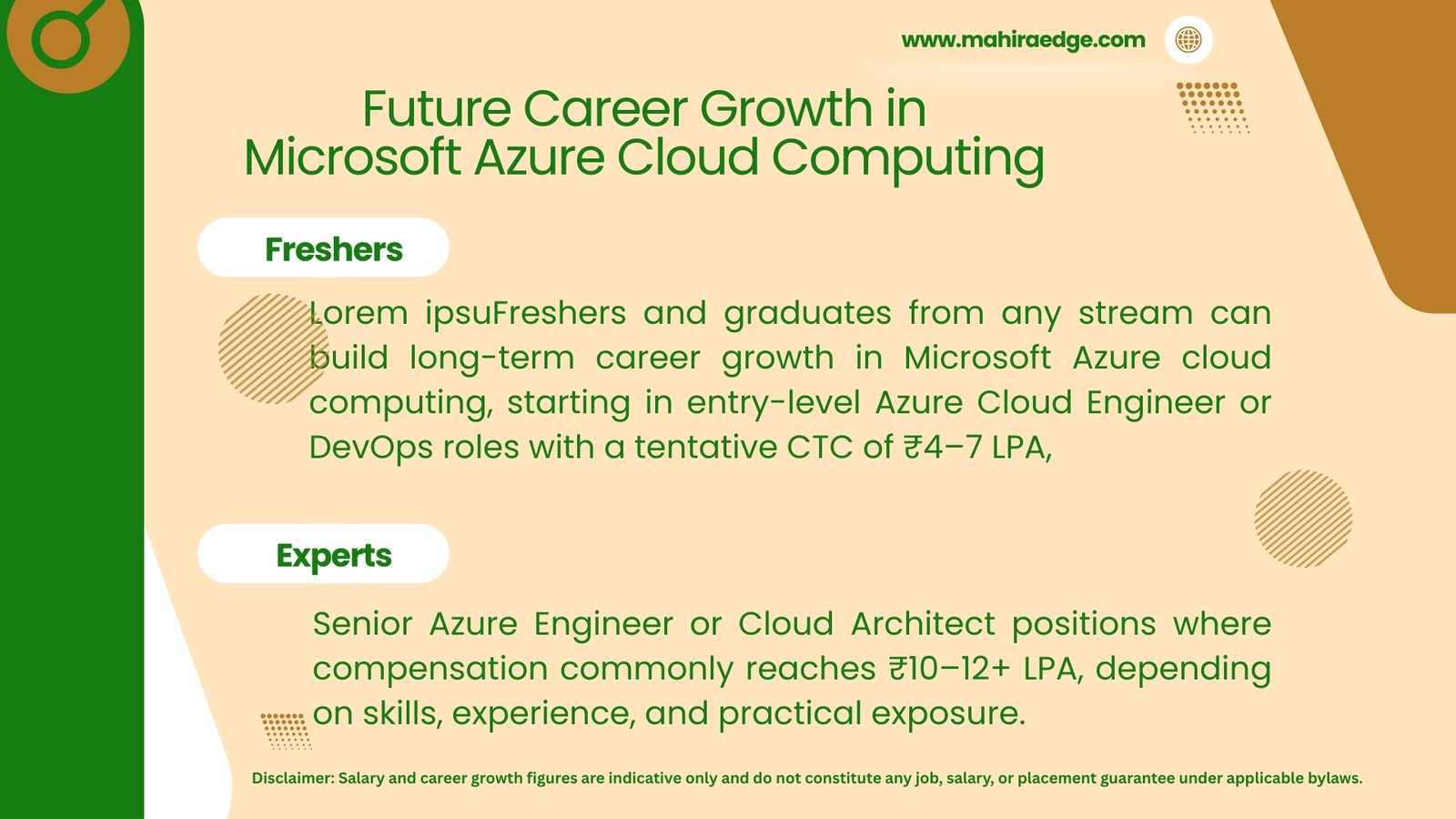
Freshers and graduates from any stream can build long-term career growth in Microsoft Azure cloud computing, starting in entry-level Azure Cloud Engineer or DevOps roles with a tentative CTC of ₹4–7 LPA, and progressing to senior Azure Engineer or Cloud Architect positions where compensation commonly reaches ₹10–12+ LPA, depending on skills, experience, and practical exposure.

- Azure cloud architecture
- Azure Resource Manager concepts
- Virtual Machines & compute environments
- Azure Storage services
- Identity & Access Management (IAM) with Azure AD
- Virtual Networks, Subnets, NSGs & routing
- Monitoring with Azure Monitor & Log Analytics
- Azure CLI & PowerShell basics
- Deployment concepts & governance

Cloud Computing Fundamentals
Understand cloud service models, deployment concepts, and the Microsoft Azure global infrastructure.
Azure Core & Compute
Learn to provision and manage Azure core services, including virtual machines and compute resources.
Azure Storage & Networking
Configure Azure storage solutions and virtual networking for secure and scalable connectivity.
Identity, Access & Security
Implement identity management, role-based access control, and foundational Azure security measures.
Compliance, Monitoring & Management
Use Azure tools to monitor performance, manage resources, and support compliance requirements.
Automation & DevOps
Apply automation concepts and DevOps practices for streamlined Azure deployments.
Certification Alignment
Develop knowledge aligned with commonly referenced Microsoft Azure certification objectives.
MAHIRA EDGE Advantage
- Instructor-led Azure console walkthroughs
- Hands-on tasks for VMs, networking, and storage
- Realistic cloud use-case examples
- Guided exercises for each service area
- Module-wise assessments for progress tracking
- Interview topic preparation and cloud-oriented resume support
(Training support focuses on learning enhancement only)
Contact

Syllabus
Module 1: Introduction to Azure Cloud
- Cloud concepts
- Azure global infrastructure
- Regions & Availability Zones
Module 3: Compute Services
- Virtual machines
- VM sizing & disks
- Availability sets & zones
Module 5: Networking with Azure VNet
- Virtual Networks
- Subnets
- Network Security Groups
- Routing basics
Module 7: Databases on Azure
- Azure SQL
- Cosmos DB basics
- Backup & recovery overview
Module 2: Azure Resource Manager (ARM)
- ARM concepts
- Resource groups
- Templates overview
Module 4: Azure Storage
- Blob storage
- File storage
- Access tiers
- Data redundancy options
Module 6: Azure Identity & Access Management
- Azure AD
- Roles & RBAC
- Security best practices
Module 8: Load Balancing & Scaling
- Azure Load Balancer
- Azure Application Gateway
- Scaling concepts

About microsoft azure
Microsoft Azure is a leading cloud computing platform used by organizations worldwide to build, deploy, and manage applications through secure, scalable cloud services. Azure supports a wide range of technologies including virtual machines, cloud storage, networking, databases, DevOps tools, and cloud security, making it a preferred choice for enterprises across industries.
Learning Microsoft Azure cloud computing helps individuals develop in-demand skills for roles such as Azure Cloud Engineer, DevOps Engineer, and Cloud Architect. Azure skills are applied across sectors like IT services, banking, healthcare, e-commerce, and enterprise solutions, offering continuous learning and career growth opportunities as cloud adoption expands globally.